
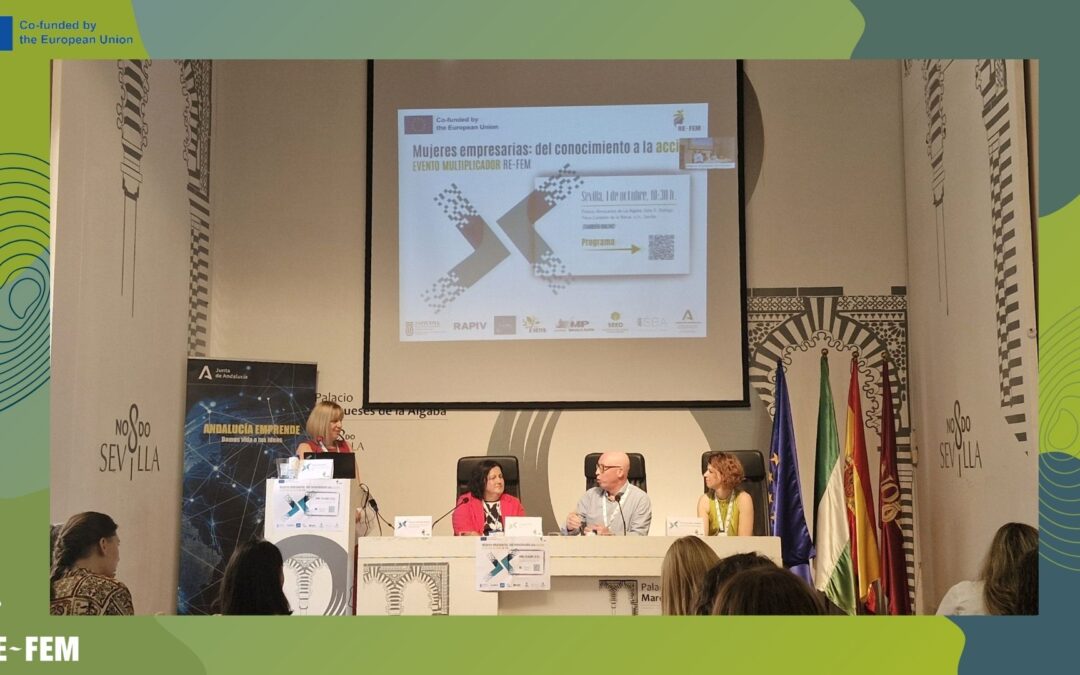
The Erasmus+ RE-FEM project – Upskilling pathways for REsiliency in the post-Covid era for FEMale Entrepreneurs successfully concluded its journey with the final multiplier event, “Women Entrepreneurs: From Knowledge to Action,” held on 1 October 2025 in Seville. The event took place at the historic Marqueses de La Algaba Palace, and was also streamed online, bringing together a wide audience from across Europe. About 200 participants were present at the event hosted by our partner, Andalúcia Emprende. This closing gathering brought together policymakers, researchers, business support professionals, and women entrepreneurs to reflect on the most relevant topics affecting women entrepreneurs today, and to discuss the project’s outcomes and impact.
The event opened with a warm welcome from Francisco Javier González Navarro, General Director of Entrepreneurship Promotion and Continuous Training at the Regional Government of Andalusia, who highlighted the importance of initiatives like RE-FEM in strengthening the entrepreneurial ecosystem. This was followed by an insightful presentation from Dr. Katalin Oborni, Senior Project Manager at HETFA Research Institute, who offered an overview of RE-FEM’s journey and shared its main results and key achievements. Nieves García Pereira, the Project Manager of Andalúcia Emprende presented a video summary of the results of the RE-FEM project, which can be accessed below. The video was prepared by Andalúcia Emprende.
Nadia Calviño, the President of the European Investment Bank Group greeted the participants. In her inspiring speech, Nadia Calviño highlighted that empowering women is not only a matter of fairness but also a catalyst for driving progress, stability and prosperity. She emphasised the need to continue investing in gender equality, ensuring that women play active roles in shaping the green and digital transitions, and called for collective action to build a truly inclusive society for future generations. Her welcoming speech is available below:
Anna Häggblom, Woman Entrepreneur and Advisor on Artificial Intelligence gave a Keynote Speech on the role of digitalization and Artificial Intelligence in the field of resilience for women led businesses. We previously featured Anna Häggblom in our RE-FEM Talk session on unlocking AI for Women Entrepreneurs. Click here to learn more about this.
A key highlight of the event was two insightful roundtable discussions. The first, held in English and titled “Resilient Futures: Supporting Women Entrepreneurs in Times of Crisis,” reflected on key lessons from the RE-FEM project and presented its Final Policy Study. The session was moderated by Sanja Popovic-Pantic, Head of the Science and Technology Policy Research Centre at the Institute Mihajlo Pupin, President of the Association of Business Women in Serbia, and Chair of the EEN Thematic Group on Women’s Entrepreneurship. She was joined by distinguished panellists such as Gabriela Kostovska Bogoeva, Co-founder and Executive Director of the Foundation for Management and Industrial Research and Vice-Chair of the EEN Thematic Group Women’s Entrepreneurship from North Macedonia; Zsuzsanna Lukács Lakatosné, Deputy State Secretary for the Protection of Enterprises at the Hungarian Ministry of National Economy and former Director of the SEED Foundation, Hungary and Ludwig Stendahl, Business Developer at Connect Norr Västerbotten in Sweden. The main take-aways of the roundtable discussion in English are the following:
- Access to finance and markets remains one of the main challenges faced by women entrepreneurs (WEs). Although there are numerous initiatives and support mechanisms in place, they are still not sufficient. It was agreed that as specific challenges continue to resurface, targeted and context-specific solutions are needed. These should be designed and implemented at the regional and local levels, where stakeholders must be further strengthened. Their capacity to provide WEs with relevant knowledge and guidance needs to be enhanced.
- It was also highlighted that many WEs often lack self-confidence when it comes to applying for business loans and may not have adequate information about the available incentives and support schemes.
- Inclusive policy-making is essential. There is a need to bring together different sectors — the business community, academia, and civil society — to ensure meaningful collaboration. Improved communication among these sectors is critical, and additional resources should be allocated to support such cooperation.
- Another important point was the need to understand why women submit fewer applications for funding, projects, and support programmes. Policies and initiatives should also address this issue by identifying and removing the barriers that discourage women from applying.
- Gender mainstreaming remains key. It is not enough to offer gender-targeted support — all policies must systematically integrate gender-sensitive measures and strategies to ensure equal opportunities across all levels.
- In terms of access to finance, the discussion emphasised the importance of innovative mechanisms and sharing lessons learned. There is a strong need to see more female innovators and investors, and to create an enabling environment where they can thrive.
- Finally, several points were raised about the importance of the entrepreneurial ecosystem. Women entrepreneurs and start-up founders often face different types of questions or evaluations compared to men — depending on the composition of the mentors, evaluators, or judging panels. This highlights how the cultural and structural context of entrepreneurship, including environmental and systemic factors, continues to influence women’s opportunities and outcomes.
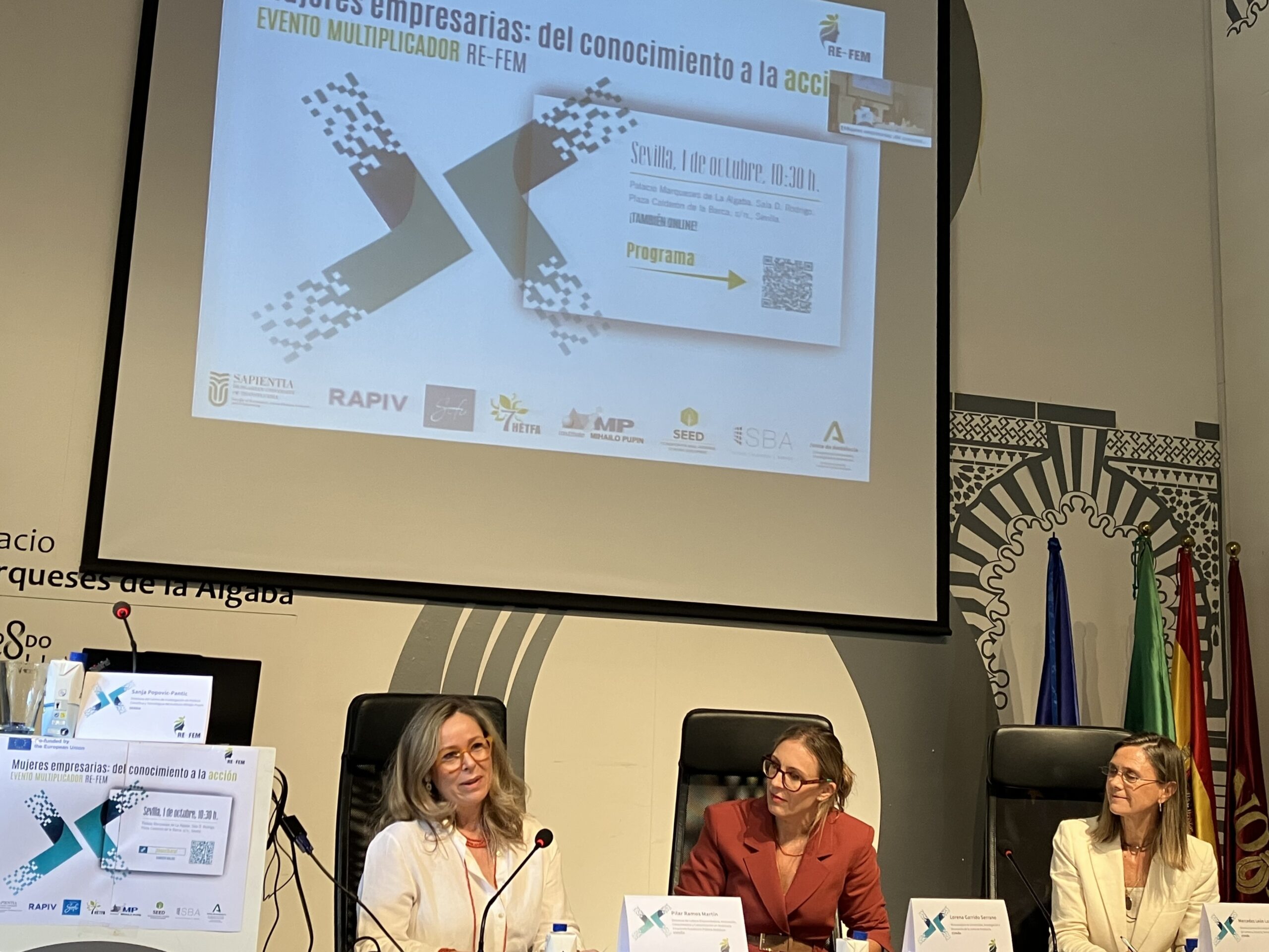
The second discussion, “Female Entrepreneurship in Andalusia: Real Challenges and Necessary Answers,” held in Spanish, focused on the regional context. It was moderated by Olga Carrión Mancebo, Director of the Andalusian Women’s Institute, and featured Lorena Garrido Serrano, Deputy Minister of University, Research and Innovation of the Regional Government of Andalusia; Victoria Cabrera de Paredes, CEO and Founder of Agencia Cps, journalist, TV producer and speaker listed among Forbes’ Influential Women in Andalusia in 2024 and Mercedes León Lozano, Managing Director of the Andalusian Council of Chambers of Commerce, Industry, Services and Navigation, and a practising lawyer. Regarding this session we summarise the inspiring thoughts of Lorena Garrido, Deputy Minister of University, Research and Innovation of the Regional Government of Andalusia:
- During her speech, Lorena Garrido emphasised that ‘business resilience is not just about resistance, but also about knowing how to transform’. In this regard, she highlighted three key skills that Andalusian women entrepreneurs need to strengthen: ‘strategic vision to adapt to change, collaborative networks so they don’t have to do it alone, and smart financial management that allows them to grow safely’.
- The Deputy Minister also outlined the work being done by her department, in close collaboration with the Andalusian Institute for Women, to ensure that these skills are available to all female entrepreneurs. ‘We work together to ensure that these skills do not depend on chance, but on real access to training, financing and support, because when a woman leads with purpose, her company becomes an engine of change,’ she said.
- Looking to the future, Garrido has defended the need for ‘bold public policies, a culture that celebrates female leadership and effective support systems’ and has called for gender-focused funding, simplified administrative procedures, innovation programmes and work-life balance measures that recognise the importance of caregiving as an integral part of the economy. ‘We also need to highlight role models, educate children about equality from an early age and normalise failures as part of the process, because when a woman starts a business, she not only creates a company, but also paves the way for others, inspires girls and redefines the future,’ she concluded.
We thank all the participants who joined us during the final event of the RE-FEM project in Seville. As RE-FEM concludes, the project’s legacy endures through the project results and networks created to strengthen women’s entrepreneurship across Europe. Together, we shall continue turning knowledge into action, building a more inclusive future for resilient women entrepreneurs.